

Though many viewers may have missed it, one of the most emotional Grey’s Anatomy episodes of all time was dedicated to Bob Verne. Since its premiere in the early 2000s, Grey’s Anatomy has irrefutably changed the television landscape for good as an unforgettable medical drama. With a rotating cast of hospital personnel, a willingness to kill off even the most beloved characters, and a soundtrack of iconic needle-drops that fans will never listen to the same way again, the Shonda Rhimes procedural is one of the most influential series of the century thus far.
Yet, there are plenty of writers, directors, producers, and below-the-line crew that have been just as pivotal to the show’s success, including Krista Vernoff. After helping hone the medical drama’s unique identity as an executive producer and writer, Vernoff was promoted to head writer and showrunner in 2007. After several years at the helm of one of the biggest programs on air, however, Vernoff confirmed in 2023 that she was moving on from Grey’s Anatomy, taking up the mantle as sister series Station 19’s showrunner.
Despite being a devastating blow to the series— and a monumentally consequential behind-the-scenes departure from Grey’s Anatomy— Vernoff’s work on the ABC original will never be forgotten. Aside from creating some of the most memorable installments in the show’s 21-year run, the talented writer also imbued some bittersweet realism into the medical drama’s early seasons.
Grey’s Anatomy Producer Krista Vernoff Wrote “Six Days” As A Tribute To Her Father, Bob Verne
Vernoff Went Through A Very Similar Experience To George O’Malley
One storyline in particular was deeply personal to Vernoff: the two-part event that spanned Grey’s Anatomy season 3, episodes 11 and 12 (titled “Six Days: Part 1” and “Six Days: Part 2,” respectively). Without question, George O’Malley (T.R. Knight) was one of the most important characters in the series, as he had been there since Grey’s Anatomy’s very first episode. During holiday episodes and a few sporadic subplots, the procedural slowly revealed more and more about his character’s personal life and backstory— including his strained relationship with his brothers and father, Harold (George Dzundza).
Though the O’Malley clan seemed to grow closer after a few heart-to-hearts, Grey’s Anatomy dropped a bombshell on George and the audience alike by revealing the family’s patriarch was diagnosed with esophageal cancer in season 3, episode 8. Beyond that, Harold’s aortic valve was leaking, which required immediate surgery. Following the success of one procedure, Harold underwent another risky surgery to hopefully remove the tumor, only for the surgeons to realize it had spread to multiple other organs. Nevertheless, Harold insisted he felt better than ever, leading his family to gather and prematurely celebrate his road to recovery.
Throughout “Six Days,” sadly, Harold takes a turn for the worse. After falling into a coma, George’s father rapidly declined into organ failure, progressing to the point where he could only rely on a life support system. George and his family struggle with the dilemma, but they ultimately decide to take Harold off of life support to alleviate his pain.
What many fans of the show likely missed, however, is that the harrowing death in Grey’s Anatomy season 3 was inspired by true events— namely, Krista Vernoff’s father, Bob Verne. Just like Harold, Verne was diagnosed with late-stage esophageal cancer and went through major surgery soon after. Though the procedure initially seemed like a success, complications quickly arose. Similar to the “Six Days” climax, Vernoff and her family made the same difficult decision as the O’Malleys and took Verne off of life support.
“Six Days: Part 2” ends with a title card that reads “In memory of Bob Verne.”
Vernoff’s bravery to incorporate her own grief into the plot made “Six Days” an incredibly moving Grey’s Anatomy story, with the two-part narrative widely regarded as a heartfelt highlight of the show’s early seasons. In an interview with Variety, Vernoff shared that she found it cathartic to tell her father’s story via Harold. Her proximity provided ample inspiration, with the episode division coming about due to the original premise running long, but Vernoff rightfully sees the two-parter as “very much [her] story,” and it remains a touching tribute to her father.
Vernoff Was Nominated For An Emmy For Writing “Into You Like A Train”
The Episode Centers On Patients Injured From A Train Derailment
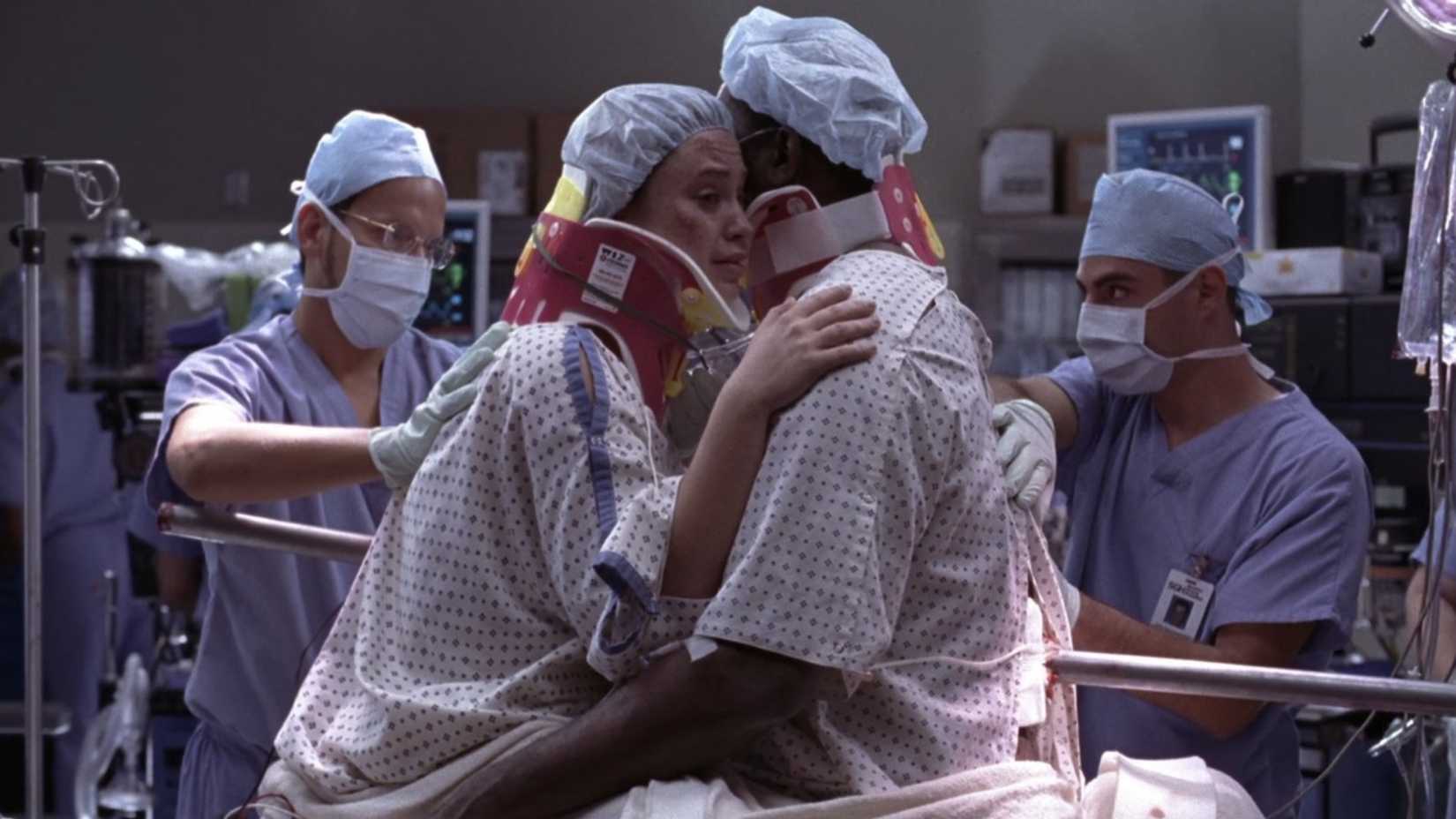
In addition to expertly crafting Harold O’Malley’s swan song, Vernoff is responsible for a masterpiece Grey’s Anatomy episode: season 2, episode 6 (“Into You Like a Train”). Before mass casualty events were a dime a dozen in the medical drama, “Into You Like a Train” explored the aftermath of a horrific train derailment. Arguably the biggest case in the episode is a pair of patients who were impaled by the same pole. As the doctors soon deduce, only one can make it out alive, kick-starting an emotional debate over which patient should be saved.
Related
10 TV Shows We Thought Would Be The Next Grey’s Anatomy
Explore the TV shows that attempted to replicate the success of Grey’s Anatomy, each offering a unique take on the medical drama formula.
“Into You Like a Train” is Grey’s Anatomy at its best, and it’s no surprise that Vernoff earned an Emmy nomination for Best Writing because of it. The loss of Bonnie (Monica Keena) was one of the first examples of the medical drama pulling no punches with its affecting deaths. In comparison, “Six Days” may feel understated, but it was a career-defining episode for Vernoff that will live on in perpetuity as a poignant moment in Grey’s Anatomy history.
Source: Variety
Release Date
March 27, 2005
Directors
Rob Corn, Kevin McKidd, Debbie Allen, Chandra Wilson, Allison Liddi-Brown, Jeannot Szwarc, Tony Phelan

Ellen Pompeo
Dr. Meredith Grey

Chandra Wilson
Dr. Miranda Bailey



