

Most of our favorite musical acts, long before they became household names in music history, were once deeply shaped by the films, songs, and pop culture they grew up with. Sometimes, some of them even continued drawing from those influences, even during their prime years, using them as inspiration to experiment and innovate. The Beatles, however influential they may be, have never shied away from borrowing inspiration from unexpected places, whether from earlier artists, literary works, or classic films. One surprising influence on their later work came from a 1956 musical comedy, The Girl Can’t Help It. That film, which currently boasts an 82% critics’ score on Rotten Tomatoes, ultimately helped spark the creation of “Birthday,” a celebratory track featured on the band’s self-titled 1968 release, more commonly known as The White Album.
The Girl Can’t Help It, directed by Frank Tashlin and starring Jayne Mansfield as Jerri Jordan and Tom Ewell as Tom Miller, tells the story of a struggling talent agent hired by a hoodlum to make his girlfriend a singing sensation — only for things to go south when the agent falls for her. She turns out to have no singing talent at all. The musical comedy was widely credited for bringing the early rock ‘n’ roll scene to mainstream audiences, featuring electrifying performances that 1950s viewers absolutely loved. Even more, the film helped solidify Mansfield as a major star, lauded for her ability to share the spotlight with other artists, such as Little Richard. It was an influential work that the young Beatles were reportedly inspired by, remaining a celebrated example of 1950s pop culture.
How ‘The Girl Can’t Help It’ Inspired The Beatles
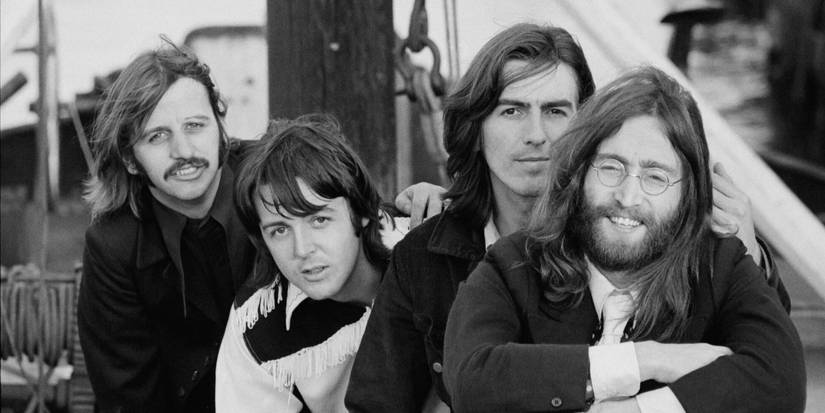 Image via Apple Corps. Ltd.
In the modern age, The Girl Can’t Help It may be taken for granted, especially since performances from different artists can now be easily accessed online. But back in the 1950s, it was a thrilling, once-in-a-lifetime delight to see artists like Little Richard, Fats Domino, and Eddie Cochran perform on screen. And it was very much a cultural phenomenon for the 16-year-old John Lennon, who — inspired by the film’s performances — began to follow his musical ambitions, having formed The Quarrymen, a group consisting of Lennon and several of his school friends.

Related
57 Years Ago, the Beatles Delivered What Is Arguably Their Best Album of All Time
A bold move that changed everything for the Fab Four.
Young Paul McCartney then auditioned to be a member of the rock ’n’ roll group, also inspired by Cochran’s energetic performances and style. With McCartney’s talent and determination, Lennon ultimately welcomed him as part of the band. And then came George Harrison, who was recruited by McCartney himself, even though Lennon initially thought he was too young at the time. That group later evolved into The Beatles, with Ringo Starr joining as the final member. To this day, some casual listeners may have never heard of The Quarrymen, but that early group laid the foundation that would eventually become the Beatles. Arguably, The Beatles wouldn’t have been recognized (or even existed) without the inspiration of The Girl Can’t Help It.
How ‘The Girl Can’t Help It’ Helped Shape “Birthday”
During the recording sessions, the band took a break to visit McCartney’s home and watch The Girl Can’t Help It. They then headed back to the studio to work on “Birthday,” channeling the film’s lively energy and infectious rock ’n’ roll spirit into the song’s celebratory sound. Released on November 22, 1968, as part of The White Album, “Birthday” — co-written by Lennon and McCartney, credited under their famed songwriting partnership as Lennon-McCartney — is as simple as it can get. It has pretty straightforward yet infectious lyrics. It goes, “They say it’s your birthday / Well, it’s my birthday too, yeah / They say it’s your birthday / We’re gonna have a good time / I’m glad it’s your birthday / Happy birthday to you.” But it’s in the song’s very upbeat and lively energy that it has found its place as an underrated gem. On creating the song, McCartney recalled:
“Normally, we didn’t have friends around for sessions, so it was very unusual. We didn’t know what song to do so we decided to make one up. We did what Roy Orbison had done with ‘Pretty Woman’ and Little Richard had started with ‘Lucille.’ Do-do do-do do-do do-do; Roy Orbison goes, do-do do-do DO-DO DO-DO- he just changes the end a little bit. We changed basically the same riff of ‘Lucille’ and ‘Pretty Woman’ into ‘Birthday’ – do-do do-do do-do-do… ‘You say it’s your birthday.”



