

When Netflix began producing House of Cards, it opened up an entirely new type of programming for them. After House of Cards, the streamer introduced new titles, including Narcos, and began producing shows that highlighted productions filmed around the world, based on true stories, and featuring iconic, infamous figures who had drug empires during their time.
Narcos tells the rise and fall of Pablo Escobar (Wagner Moura) and how cocaine production and sales influenced organized crime in the world, as well as escalated crime around the world, during the 1980s to the early ’90s. In contrast to simply presenting the story, Narcos uses the mythology of this genre to tell it from two completely different sides: those of criminals and politicians, as well as members of the law enforcement community.
When watching seasons one and two, we see that the formula of telling the story from different perspectives was used very effectively to create a mix of drama and high-stakes edge-of-your-seat excitement. As the show produced additional seasons, it continued to build its universe beyond Escobar’s reign, but many viewers associated the series with Escobar.
‘Narcos’ Builds a Crime Epic From Real History
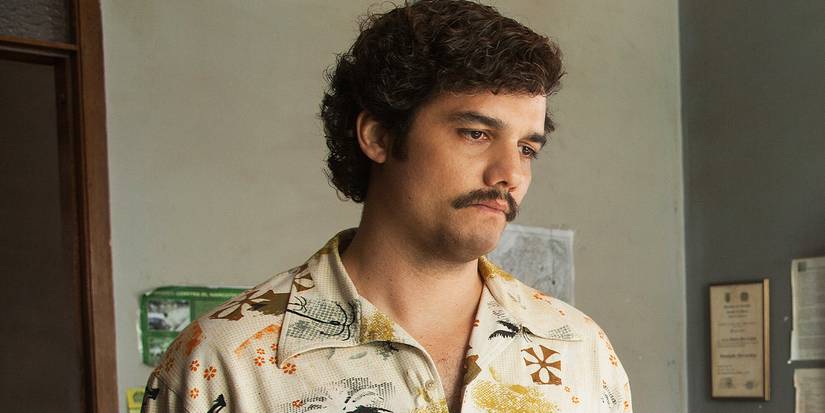 Image via Netflix
The story begins with Escobar as a small-time smuggler moving illegal goods into Colombia. Before he knows it, an even larger opportunity presents itself to him. This is the time when there are great amounts of cocaine being consumed within the United States, and to meet that demand, the Medellín Cartel has swiftly made itself available.
As the story develops, it follows the progression of the operation — from developing more labs and creating more distribution routes to ultimately becoming a global enterprise that will generate billions of dollars.
Steve Murphy (Boyd Holbrook), the DEA agent serving as a sort of narrator throughout the show, provides a reference point for viewers to understand the time frames of the events shown. Murphy and another DEA agent, Javier Peña (Pedro Pascal), journeyed to Colombia to attempt to shut down the cartel; however, they discovered that the cartel was growing exponentially faster than they had anticipated.
Adding to the show’s creativity and contributing to its documentary feel compared to other traditional crime dramas is the use of archival film footage and photos. The series uses actual news footage and comics from this time frame, allowing viewers to connect more easily with the timeline.
For all its sweeping history, Narcos ultimately works because of Moura. His portrayal of Escobar avoids the cartoonish villainy that often accompanies crime dramas. Moura plays him as something far more unsettling — calm, calculating, occasionally reflective, and capable of extraordinary brutality when challenged.
The series leans into Escobar’s contradictions. He orders assassinations and bombings, yet insists he’s helping Colombia’s poor. He pursues political office while running one of the world’s most violent criminal networks. Those tensions give the character a strange gravity on screen. Critics took notice; Moura’s performance quickly became the show’s biggest talking point and even earned major award nominations.
Critics’ response to the combination of historical facts and suspenseful drama was positive as well, with the show receiving a 79% rating on Rotten Tomatoes and a 77 Metacritic rating for the first season; many reviews praised the writing and the suspenseful action. Not everyone was sold on the narration-heavy style, but most agreed the series had an undeniable momentum.

Related
Strap on Your Hockey Masks; It’s Friday the 13th — The Collider Movie Quiz!
Because today is Friday the 13th, let’s march our way through the iconic slasher franchise. Ch-ch-ch-ch. Ha-ha-ha-ha.
The Show Changes After Escobar — But It Still Works
 Image via Netflix
Instead of stretching Escobar’s story indefinitely, Narcos wraps it up after two seasons and pivots toward the Cali Cartel. The shift changes the tone almost immediately. The Cali leaders operate differently: they’re quieter, wealthier, and more strategic, running their organization with the efficiency of a multinational company rather than the chaos Escobar thrived on.
Pascal’s Peña becomes the central figure as the DEA turns its attention to this new threat. The third season introduces a fresh wave of characters and explores how deeply the cocaine trade had embedded itself in politics and business. The transition turned out better than many expected. Season 3 holds 96% on Rotten Tomatoes and a 78 Metacritic score, with critics praising the show’s ability to stay engaging even after losing its most famous character. Some reviewers noted that the early episodes take time to settle into the new storyline, but once the season finds its rhythm, it becomes one of the show’s most suspenseful stretches.
Why ‘Narcos’ Still Stands Out in Netflix’s Catalog
 Image via Netflix
Nearly a decade later, Narcos remains one of Netflix’s defining early originals, and part of that legacy comes down to timing. The series arrived just as the platform was beginning to compete seriously with cable networks. However, it was not only that Narcos showed us an amazing story; it did so by revealing a much larger narrative than that of a single narcotics dealer’s empire.
Narcos demonstrates to the viewer that the drug war was not strictly about the battle between the drug dealers and law enforcement agencies battling each other, but rather also very much related to the politics and power that surround the situation, and how people will create stories for themselves in order to justify both. For at least the first two seasons of the series, Narcos was able to combine these elements effectively enough that they made it difficult for you to stop watching.



