

By Chris Snellgrove
| Published 16 seconds ago
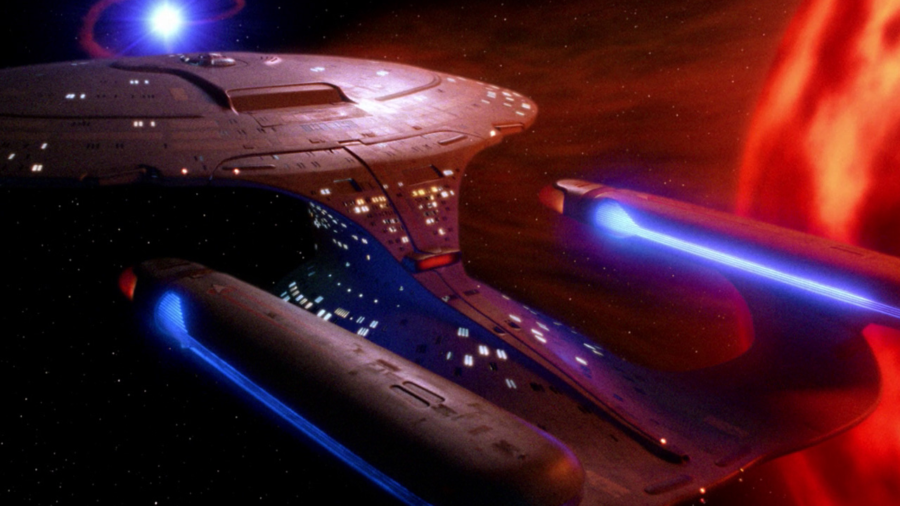
After Enterprise fizzled out, a new film brought the world’s greatest sci-fi franchise back to life: Star Trek (2009), a snazzy reboot that brought back the characters and impeccable vibes of The Original Series. To mollify fans worried that the new film would completely retcon older Star Trek media, Paramount set all of its Trek reboot films in a parallel universe that was completely different from the familiar “prime” universe. What most fans don’t realize, though, is that this parallel “Kelvinverse” (so named after Kirk’s father’s doomed starship) would have been impossible without “Parallels,” an often-overlooked episode of Star Trek: The Next Generation.
In that episode, Worf returns from a bat’leth tournament only to find himself slipping in and out of different realities; this allows him to experience the lives of different Worfs while seeing how different things could be aboard the Enterprise-D. He is married to Deanna Troi in one reality, for example, and is the first officer of the ship in another. Eventually, Worf (with the help of Data, Geordi, and the rest of the senior officers) discovers that this all started because his shuttle accidentally weakened the barrier between different quantum realities, and he is able to fly back to his own reality while closing the dimensional fissure behind him.
How Worf’s Multiverse Adventure Created The Star Trek Reboot

This makes for a fun episode (especially if you’re a Worf fan), but what does this story have to do with Star Trek (2009)? Back in 2008, that film’s cowriter, Bob Orci, gave an exclusive interview to TrekMovie, and their conversation focused primarily on how the new movie’s timeline could exist without erasing all the franchise lore that came before it. Orci basically gave fans a crash course on quantum mechanics, and he cited Data’s comments from “Parallels” to sum up that “all possibilities that can happen do happen” in various other realities.
That may sound pretty basic, especially for those who are familiar with Marvel’s various movies and TV shows involving the Multiverse. But the MCU was less than a year old when Orci gave this interview, and the Multiverse was not yet even a sparkle in Kevin Feige’s eye. Therefore, the writer walked Trek fans through how the upcoming Kelvinverse film was rooted strongly in both real-world quantum mechanics (which the interviewer helpfully pointed out is known as the Many Worlds Theory) and the Trek lore established in “Parallels.”
The Many Yawns Theory?

For Star Trek fans, the Many Worlds Theory is both blessing and curse: it allows for telling stories in different realities, contextualizing settings like the Mirror Universe and explaining how the Kelvinverse and any future reboot realities can exist alongside the Prime Universe of shows like The Original Series and The Next Generation. But (as Red Letter Media recently pointed out), this theory arguably cheapens the drama of the choices our characters make. Not only is there a dimension where they made a completely different choice, but the existence of countless other dimensions means it doesn’t really matter who lives and who dies because everyone is alive somewhere else.
Whether you love or hate the narrative sandbox it created, “Parallels” paved the way for the existence of Star Trek (2009), a movie that saved the franchise when Trek was falling into cultural obscurity. Those reboot films are controversial among some fans, but their success undeniably helped make Star Trek into a mainstream hit once again. If you’re one of the fans who hated it, that probably won’t bother anyone involved; after all, quantum mechanics tells us that there’s a universe out there where this is your favorite film series of all time!



