

For decades, Fallout has trained audiences to look underground for its worst secrets. Vaults hide experiments. Vaults warp people. Vaults are where the real horror lives. But in the Season 2 finale, Fallout finally says the quiet part out loud, and in doing so, reframes the entire franchise.
“The surface is the experiment, not the vaults.”
Spoken by Hank Maclean (Kyle MacLachlan), the line isn’t a shocking revelation so much as a confirmation. It’s the thesis Fallout has been circling for years, now stated with brutal clarity. The vaults were never the end goal. They were infrastructure. The real test has always been what happens when humanity is released back into a world shaped by controlled collapse.
The Vaults Were Always a Distraction
 Image via Prime Video
From the beginning, the vaults have functioned as misdirection. They are grotesque, self-contained, and easy to catalog as evil. Each vault has a premise, a variable, a failure point. They feel like the obvious crime scene. But Fallout has always been more interested in what happens after the experiment concludes. Season 2 makes that explicit. The surface isn’t chaos born from negligence; it’s chaos by design. Societies are allowed to form, fracture, and weaponize ideology without intervention. Factions rise believing they are restoring order, never realizing they are still operating within parameters established long before they existed. Hank’s line confirms that the vaults were never meant to preserve humanity in isolation. They were meant to shape what kind of humanity would emerge when isolation ended.

Related
‘Fallout’ Season 2 Just Hinted at the Sci-Fi’s Most Unexpected Alliance Yet
The Season 2 ending hints at a collaboration no one saw coming.
Control Never Stopped — It Just Became Invisible
What makes this revelation so dark isn’t that someone is watching. It’s that the watching never required interference. The experiment succeeds precisely because the surface world believes it is free. Season 2 repeatedly emphasizes how institutions persist even when morality fails. Power structures inherit the language of survival and dress it up as necessity. Leaders speak in terms of protection and order, never questioning whether the framework they’re enforcing was designed to be humane in the first place. By positioning the surface as the experiment, Fallout reframes its central tragedy. Humanity isn’t being punished for its mistakes: it’s being observed while repeating those mistakes under slightly altered conditions. Progress is measured not in justice or compassion, but in predictability.
This Changes How Every ‘Fallout’ Story Lands
Hank’s line retroactively sharpens the entire franchise. It explains why no faction is ever allowed to fully “win,” and why every attempt at rebuilding recreates hierarchy, exclusion, and violence. The surface world isn’t meant to heal — it’s meant to demonstrate how power inevitably reorganizes itself when left unchecked. This is also why Fallout has always been skeptical of saviors. Anyone claiming to fix the world is unknowingly validating the experiment’s premise. Stability achieved through control is still control. Civilization rebuilt on old logic is still part of the test. Season 2 forces its characters — and its audience — to sit with that realization. Lucy’s belief in moral choice collides with a system that was never designed to reward it. Maximus’ loyalty fractures as he begins to see how easily institutions survive by consuming those who serve them. Hank’s calm certainty is perhaps the most chilling response of all: acceptance without resistance.
The Horror of ‘Fallout’ Has Never Been the Bombs
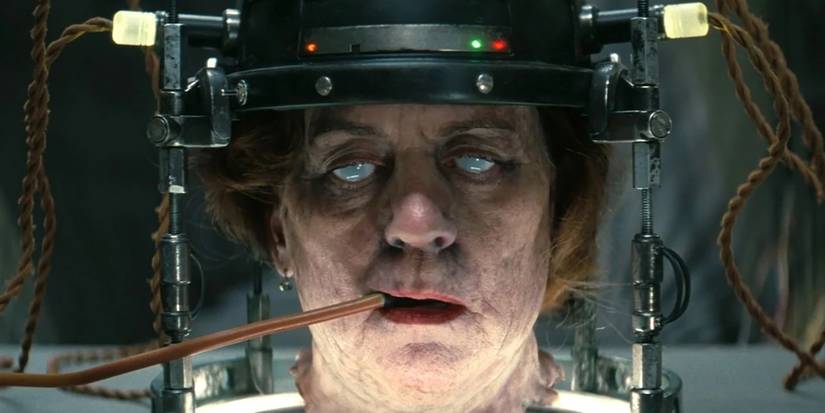 Image via Prime Video
One of the most unsettling implications of Hank’s statement is how little resistance the experiment now requires. There is no singular villain pulling strings, no dramatic reveal of a mastermind intervening from the shadows. The system perpetuates itself through belief alone. People inherit the logic of the old world and enforce it willingly, convinced that survival demands repetition rather than reinvention. In that sense, the experiment has succeeded beyond its designers’ expectations. The darkest realization Fallout offers in its Season 2 finale is that the apocalypse wasn’t the catastrophe: it was the setup. The real horror is how cleanly humanity stepped into the role assigned to it. The vaults feel cruel because they are visible. The surface feels natural because it isn’t. By flipping that perception, Fallout exposes its most unsettling idea yet: that freedom, in this world, is just another variable being tracked. “The surface is the experiment, not the vaults” isn’t a twist. It’s a confession. And once it’s spoken, it becomes impossible to see Fallout — past, present, or future — as anything other than a long-term study in how willingly humanity rebuilds the systems that destroyed it. Season 2 doesn’t just deepen Fallout’s lore: it clarifies its worldview, and it confirms that the franchise’s darkest truth was never buried underground at all — it was always playing out in plain sight.
Release Date
April 10, 2024
Network
Amazon Prime Video
Showrunner
Lisa Joy, Jonathan Nolan



