

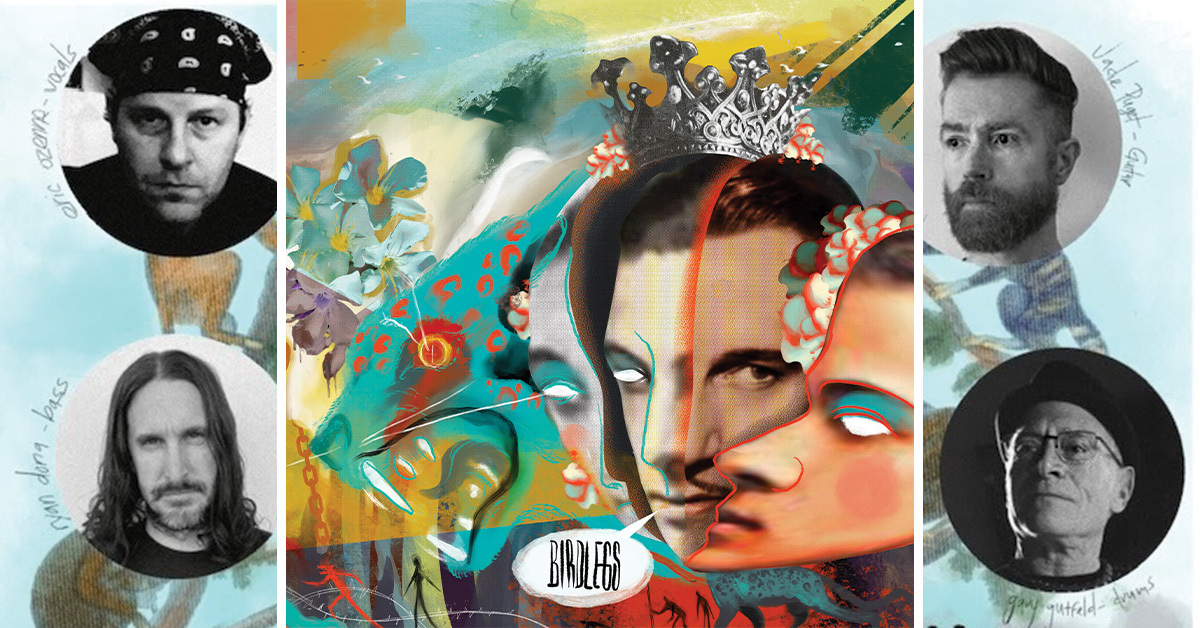
Birdlegs bring together Jade Puget (AFI), Gary Gutfeld (Corduroy, the Hi-Fives), and Eric Ozenne (The Nerve Agents) — all of whom played side by side in Northern California’s Redemption 87 back in the late ’90s — along with bassist Ryan Doria (Overexposure), delivering a surge of high-energy hardcore that is chaotic, nostalgic, and strikingly relevant. It offers a hefty dose of mid-’90s hardcore, while lambasting social media culture, and the warped societal structures that exist in our modern world. Though each artist has experience and prestige in the alternative space alone, their goal with Birdlegs was never to build a shiny “supergroup” that would stretch and contort for success. “This is my favorite way to hang out,” Gutfield explains, “putting a band together with good friends and creating music together, with a positive message.”
Read more: 30 essential alternative albums turning 20 in 2026
This mantra is not only the onus for Birdlegs, but it is at the heart of hardcore. It is the blood that runs through the East Bay scene they came up in — a rowdy mix of artists eager to connect with each other and express themselves, above all else. Like projects, or their peers’ in the mid-’90s, Birdlegs’ sound is feverish and fast-paced, built on a foundation of pummeling, relentless rhythm from Doria and Gutfield, and driven home by the elite combination of Purget’s guttural, dark guitar parts and Ozenne’s brash vocal prowess. Following the release of their first, furious, satiating single, I couldn’t wait to speak with them about their forthcoming full-length, Visions Beyond the Ape Cave. Here is our conversation.
All of you came up in the East Bay scene and played together in Redemption 87 in the late ’90s. What sparked the idea to reconnect and start a new project now?
GARY GUTFELD: Eric and I started a band between Redemption 87 and now called Said Radio. We put out a CD on Mankind. We stayed in touch and basically got the itch to play, and I feel we had something to say. This is my favorite way to hang out — putting a band together with good friends, and creating music together with a positive message. It’s been a great experience for me.
JADE PUGET: Eric called me up and asked me if I wanted to be in a new band with him and Gary, and I jumped at the chance to make music again with my old Redemption 87 friends. Ryan has also been a crucial part of the mix. He’s a great player and songwriter, too.
ERIC OZENNE: Truly. Ryan has been integral. Gary and I were already mulling around starting up a new project, but it was Ryan that really made it happen by reaching out randomly in a message he sent along with his band Overexposure’s new record. This was a few years back. I didn’t know Ryan at all, and he had said he would be down to play bass if I was in the market. I believe that was intended as a potential offer to play bass if the Nerve Agents ever had the need. The Nerve Agents weren’t playing and didn’t have any intention to, so I asked Ryan if he was interested in a new project. He was. Is that accurate, Ryan?
RYAN DORIA: This is accurate! Eric gave me some great advice when I was putting together the first Overexposure record. I always try to send copies of records I produce to everyone involved, with handwritten letters. I sent Eric the record with a note thanking him for taking the time to chat through some things with me, and yes, I think I ended it with a “PS: I play bass if you ever need a bass player,” and yes, that was hinting at offering to play bass for the Nerve Agents if the need ever came up. I’m glad I did because now we have Birdlegs — a new, unexpected offering that EBHC fans can enjoy and a creative outlet for the four of us.
I actually asked this in our AFI cover story, but how do you think the East Bay shows up in this music? If at all, how can we hear that, sonically and/or ideologically?
GUTFELD: I was born and raised in the East Bay. I don’t think you can get any more of a representation than that. Eric is also from the East Bay. My early days music influences were from seeing all of the local punk bands (SF, Oakland, and San Jose) and making friends filling in for their drummers, etc. It’s still a community of sorts. We are just a little older. Punk/hardcore music has been a way of life for me.
PUGET: We’re the musical products of the East Bay. I grew up an hour-and-a-half north and lived in Berkeley for over a decade, soaking up every bit of the musical atmosphere. Birdlegs, to me, is a synthesis of the East Bay aesthetic mixed with the 1980s, primarily New York, hardcore.
OZENNE: Ideologically, there is somewhat of a David versus Goliath thread that rings throughout the Birdlegs lyrics. It’s a sensibility that has been in me for a long time.
I was born in Oakland, raised in the East Bay suburbs when my mom couldn’t afford raising her two kids on her own. We moved into my grandfather’s home. I left after high school and then came back to Oakland, Alameda, Berkeley. The East Bay is something really unique. Even outside of just the punk/hardcore scene, there is such an overall profound voice coming from diverse cultures. It’s just pervasive and fuels the thinking throughout these East Bay communities.
East Bay, musically, has always felt like it’s being drawn out of these voices, or these primary roots of a historical Oakland working-class and the 1960s radical Berkeley history. The East Bay has always had such a diverse population of residents, and with that, you get so many types of perspectives, and I feel like a general openness to differences within the music scenes, definitely the punk and hardcore scenes. The East Bay suburbs where the culture was mainly very conservative values steeped in an abundance of wealth, that was what I was psychologically opposed to growing up, which is why I was in a punk band, which is why I went to Gilman Street on many of my weekends when it opened in [the late ’80s]. As much as I didn’t exactly fully appreciate what was happening at Gilman Street in those early days, I certainly was raised in a peripheral sense within its culture.
This idea of generating questions through the communication of words and music is something I learned in the East Bay through bands like MDC, Operation Ivy, Dead Kennedys, Rabid Lassie/Breakaway, Christ on Parade, Corrupted Morals. It’s in my blood at this point.
DORIA: I’m from Orange County, not the Bay Area, but I was inspired to play music from the records coming out around my formative years (1999-2003). Bands like Rancid, AFI, the Nerve Agents all stood out to me. All with amazing bass players, and all coincidentally coming from the Bay Area. I learned my instrument by learning how to play their songs. I think this style of playing is well-represented on the Birdlegs LP, and it all traces back to EBHC bands and the impression they left on me.
When you first started writing together again, did the chemistry feel like picking up where you left off in any way, or did it feel like you were starting over entirely?
GUTFELD: For me, it was picking up where we left off. We had our first rehearsal in OC with Ryan and Eric, and it was great. Ryan and I were even able to write a song together in our downtime. I don’t think we were there for very long. Maybe a couple of hours. That is an awesome feeling.
DORIA: That was so much fun, Gary! Yeah, there was an overwhelming sense of excitement because we had a blank canvas, and we could create whatever we wanted. We pulled from a variety of different influences, and it all came together quite organically.
PUGET: For me, it’s been contributing remotely since we’re all so far-flung. Luckily, the technology makes it possible to collaborate in this way.
OZENNE: OK seriously, these guys are pretty much the same people I knew in 1997. It’s really great. I feel like the three of us have pretty much had the same chemistry as we did back when Gary would pick up Jade in his truck and drive him to band practice in downtown Oakland.
Since last playing together, you’ve all spent time in other bands, doing different things. How did those individual paths shape the sound you landed on here?
OZENNE: Jade wrote these great new songs for Redemption 87’s All Guns Poolside once upon a time. I didn’t feel the vocals really did his songs justice. With Birdlegs, I had already come into my own voice through the Nerve Agents and Said Radio, so it brings a piece of — no pun intended — redemption to be playing with Jade again. The vocals are more expansive in ways, and I intentionally chose to be more creative coming at the Birdlegs songs in ways I never had in any previous band. I am no longer trying to sound like I am singing for Youth of Today or on the Thou Shalt Not Kill Antidote seven-inch or as Straight Ahead’s Tommy Carroll. All great influences that formed how I come at vocals and are still very present in what I do, but now it’s more just me being me, a little weird and really pissed.
Speaking of vocals, I want to give a shout out to Shaina Broadstone of Twinsign for the incredible vocals she put on this record. She and Jade are in the band Twinsign together. I had been having a lot of fun coming at the backing vocals in different ways. It’s been a blast in this band to open up creatively. In my demoing vocals for the songs, I was using various types of vocal styles and highs and lows. Pretty much inspired by Aldous Harding, PJ Harvey, and the early Talking Heads. So I was doing these crazy voices. Jade was trying to figure out what the hell I was doing. He said something like, “If you want it to sound like what you are describing, let’s get someone who can actually do that type of voice.” He reached out to Shaina, and she came in, and both Jade and her nailed what I was attempting to do. Actually, they were much better. Shaina is backing vocals on the songs “The Unraveling,” “Icebox,” and “Devils Own Grip.” It’s so good. Thanks, Shaina. Jade and I didn’t talk vocals, probably ever, in Redemption 87, but both our paths really did bring quite a bit of growth and experience to Birdlegs, and it is definitely apparent in the communication we have had around vocals.
GUTFELD: I have played in a lot of bands in between. Most of them were punk, alternative pop punk, psychobilly, and even Americana with some high school friends. I always come back to playing fast and hard music. I don’t stray off from it much. I feel playing other music gives me the tools to do other stuff within the harder music I play.
PUGET: I have to imagine that playing in the same band for 28 years has fundamentally shaped my playing and writing. I’m bringing in elements to the songs I’m writing that I wouldn’t have thought to explore when I was playing hardcore in the mid-’90s.
What made this the right moment in time for this lineup to come together?
PUGET: Kismet? Serendipity? Who can say, but I’m glad it happened.
OZENNE: Kismet!? I had to just look that up. Oh yes, kismet indeed.
GUTFELD: Eric and I stay in touch quite a lot. In one of our check-in conversations, it came up to do another music project. We talked about who should be in this band. There was talk of continuing where we left off with Said Radio. It needed to have a different lineup to allow it to happen. Eric might have more to it. I say the rest is history. This lineup was ideal and perfect for what makes up Birdlegs today.
OZENNE: That’s right. Gary and I had discussed with Ryan previous to Jade joining up with us the possibility of starting up our last band, Said Radio, with Ryan doing the writing. When Jade came into the fold, we scrapped that idea very quickly.
When you started Redemption 87, who were your biggest hardcore influences? Do those still pertain when it comes to Birdlegs — and if not, who would you say has inspired you musically lately?
PUGET: My biggest hardcore influences in the early and mid-’90s were a mixed bag of Youth Crew bands like Youth of Today, Bold, Gorilla Biscuits, bands like Judge, Madball, Agnostic Front, as well as the new breed of bands that were coming out like Earth Crisis and Snapcase. Lately, I’ve been revisiting bands like Merauder, Terror, Hatebreed, and Integrity, as well as newer bands like Knocked Loose, Planet on a Chain, Drain, etc.
GUTFELD: I am a little older than the rest of the band. My influences come from the same bands as they have. I will have to show my age a little: Bad Brains, Minor Threat, a lot of British bands and California hardcore like Circle Jerks, Descendents, Minutemen, Bad Religion, DK, and others. Canada’s Subhumans and Nomeansno. And a mixed cassette tape of NYC hardcore bands that Eric gave me.
OZENNE: During the Redemption 87 days, it was very clear: Youth of Today, Gorilla Biscuits, Uniform Choice, Cro-Mags, Sick of It All, who had just released Scratch the Surface around that time, early ’80s 7 Seconds, Bad Brains, Antidote’s Thou Shalt Not Kill, Straight Ahead, and it’s all still there, but now with so much more. For me and Birdlegs, add all of those influences with PJ Harvey, early Talking Heads, Aldous Harding, Dag Nasty, TSOL, Dead Kennedys, DI, Snapcase, Hildur Gudnadottir, Fugazi, and Ignite.
Ryan, what have been your influences with Birdlegs?
DORIA: As Gary and Eric mentioned, for a brief moment, this was potentially going to be a Said Radio part two, so my first batch of songs was built around what that might sound like. I obviously tapped into Said Radio, Ceremony, etc. When that idea was scrapped, the sonic possibilities opened up. I was taking inspiration from both East Coast and West Coast hardcore bands like Youth of Today, Gorilla Biscuits, Rancid, and Dead Kennedys — all of which can be heard in songs like “Emergence” and “Visions Beyond the Ape Cave.”
I’d love to hear more about the concept behind “Mind In The Margins,” and what urged you to take the psychological impact of social media on, as a song?
OZENNE: The song is directly aimed at social media and its program designs. It’s aimed at tech companies that knowingly are taking part in the creation and implementation of social media apps and the programs designed to be addictive. The very essence of the problem with social media for me is that the intention behind so many of these apps is to psychologically manipulate the people using social media. This isn’t a well-understood thing for many people I have encountered. I would guess most people don’t understand the complexity of what is happening to them. There are questions laid out within the song, but it all boils down to whether it is important to be aware of what I am engaging with and the implications it has for me personally and on a larger scale. I am always hopeful someone will get something out of these lyrics.
Eric, the lyrics ask “Do you mind?” repeatedly. Do you see this song as a message and challenge to listeners or more of a reflection of your own frustrations?
OZENNE: All of the Birdlegs songs are really designed to ask myself these questions. So I am asking questions, but as I learned from hardcore/punk music growing up, we communicate in these communities by raising questions and talking to ourselves and with others. This is rich ground for critically checking in with your stance, values, issues, or even who you are. The lyrics have always been meant to be thorny. For me, I have always appreciated lyrics to be a challenge to the listener. If I wanted safe and easy, I would throw on an Olivia Newton-John record. Question everything. Question yourself, question my lyrics, question norms, question it all, and then ask more questions when you are frustrated, like me. It’s both frustration and clearly a message with challenge built in.
The question “Do you mind?” is asking whether I mind that a social media app that is programatically designed to psychologically addict me to being engaged on my screen, isolate me more, and essentially keep me on my apps as long as possible. That purpose is to get me to click and scroll, respond, and comment on more and more content. All that personal info that I might have thought was private, like what I say, who I talk to, whose photos I am looking at, and what kind of photos, what kind of websites, topics I am searching, all of it is being sold off to advertisers. All of this is taking place for profit. People are making money off my being unaware of what is happening to me when I am using these social media apps. Exploitation. The companies doing this kind of program design are making billions by doing so. There are so many social issues around this, to do with our collective mental health, polarization and rise of divisiveness, how we interact as human beings in connection with one another, definition of communal space, privacy and data protection, and erosion of local cultures. For me, there are huge issues to think about and whether I want to take part. So I am in a process now, taking a look at how I personally engage with all of this technology — social media, AI, and whatever else is on the horizon.
Without regulation on the tech companies that are using your data in this way, we fall prey to intentionally addictive products that have vast influence over the whole of our humanity. The Center for Humane Technology is doing work to try and make inroads into that community and politically around legislation. Same people created The Social Dilemma documentary on Netflix, if you don’t want to take my word for it, since I am by no means any kind of expert in understanding this stuff. I am continually learning myself. Go watch this documentary if you can access it, and then ask “Do you mind?” what is being done to you.
One question that keeps coming up is, “Who is going to step up and regulate social media and even AI and whatever else is coming?” Maybe no one. Certainly not this current administration in the White House. Maybe a movement is coming? Maybe it’s an underground movement that begins to grow or just a grassroots campaign that finally gets to the right person in power. Look at The Luddite Club that started out of NYC. They have been pushing back for a few years now, and they have clubs spreading nationally. The Luddite Club has a voice, and that’s a pretty good start. Maybe some kid who buys the Birdlegs record and hears this song and becomes moved to start talking about things like the topic of social media and regulation and the future of our shared human existence, then starts a zine or a band or writes a book that spreads the questions about social media and tech companies and that further kicks off political noise and potentially regulatory hearings, leading to some passable legislation. Who knows? Sometimes it’s just a hardcore song that starts the fire.
Hardcore has always been political and socially aware — how do you see social media fitting into that tradition of critique? And also, why do you think hardcore has always been such a steady space for angst, overall?
PUGET: Certainly social media is ground zero for societal critique, protest against injustice, and dissemination of information, so rather than fitting in, it’s become the focal point. Hardcore has been a consistent outlet for angst, for outsiders, for the marginalized, since the beginning. It’s a cathartic form of music, a way to express outrage and anger in a hopefully constructive way. You can see from the very inception of hardcore that it was a communal space that accepted people who felt cast out from society, people who felt pushed to the margins.
GUTFELD: I couldn’t have said it any better than Jade did. I appreciate music with a message. A positive message with heart. I have a hard time with mindless lyrics unless they are already known not to be taken too seriously.
OZENNE: Agreed.
How have you seen social media change how punk scenes form and function compared to when you all started playing?
GUTFELD: I am not a big social media person. I do like seeing live bands. It is great to see bands that you never had a chance to see in the past, and also a way to see new bands that have not toured my way. I also like to learn about the bands from the past, to where there was no way to get the information on them like you can today.
DORIA: I’m torn on social media because it’s terrible, yet it makes it so easy to find things that interest you. I was introduced to punk by a couple of skaters with mohawks and studded jackets at the end of my street when I was 8 or 9. They made me mixtapes of bands like Misfits, Subhumans, Dead Kennedys, Bad Religion, Black Flag, etc. Kids can now just open their phone and find a new band or interests based on an algorithm. Kind of cool and creepy at the same time.
OZENNE: Steve List in the East Bay would bring his xerox-copied listings around to punk shows and hand them out for free. He had hundreds of show listings for each month on his handouts. Aw man, Steve List. When he would come around, it was like seeing a character you were keeping an eye out for at Disneyland or Great America, because everyone needed “the list” to even know what shows were happening and where. For many of us, that’s how we knew of shows outside of calling one another or getting word of mouth or band flyers by members handing them out.
When I was in the Nerve Agents, message boards became a thing, and we were able to connect through MySpace. So there was much greater reach when the internet came into the equation in the late ’90s. We had things like email lists for bands we could get on, that kind of thing.
Today, the reach is incredible. Someone in Cologne, Germany can reach out as soon as they see a band post that they are playing a show in a month, and the person could conceivably book a ticket and fly to Oakland to see a reunion show. That’s very different. I have a friend (Yo CoolC!) who lives in Florida who regularly texts me flyers he finds on Instagram to shows in NYC, LA, or SF and asks if I am going. I never go anywhere, since I don’t have the money, but he tells me and sends me pictures of people he runs into at the airport or on the plane. It’s crazy. It’s like the hardcore global village. So it’s much different in that sense. Local scenes are infused with people from all over on a regular basis due to the reach of social media/internet. That used to be more of an event if there was a massive show, last show, or reunion show for a band.
With the pandemic, there was an amazing use of social media with the bands False Flag and Surprise Privilege from the Bay Area playing to hundreds of people who showed up on a BART Train. GEL played at a Sonic Drive-In with Scowl. There were some sudden Denny’s pop-up shows. You generally can’t do these kinds of shows without social media, where hundreds are showing up. Unless it’s a secret show, like the one we once did with Beastie Boys (aka Quasar), when we were in Redemption 87. That show had Sick of It All and MCM and the Monster at Bottom of the Hill, in SF. The radio station Live 105 leaked that it was Beastie Boys as Quasar, and 3,000 people showed up to a 300-capacity venue, and tons got arrested, including Brian Wentrup (RIP), who missed his favorite two bands SOIA and Beastie Boys. I still have to laugh at that.
The PR mentions Birdlegs questioning the “unraveling state of affairs.” What issues or themes are you most interested in confronting through this band?
OZENNE: It’s definitely about questioning. This time that we are living in, with the rise in technology and its permeation throughout our lives. The political chaos that only seems to get worse as we move forward through the last 20 years. The polarization of this country is swirling all around us in a myriad of ways. I have come to this music in Birdlegs with questions for myself about who I am in this time. I have mentioned before that I am questioning myself in the lyrics, but it’s also hard for me not to think collectively about who “we” are as a whole, so some of that slips through, too. Always, there is an invite for the person listening or reading these lyrics to ask themselves these same questions.
Is Birdlegs meant to be confrontational, cathartic, or something else entirely for you as musicians?
PUGET: Speaking for myself, it’s been primarily a cathartic musical outlet. I hadn’t written in this way, primarily “hardcore,” in 30 years, so it was incredibly fresh and inspiring to rediscover my love of writing this kind of music.
GUTFELD: Definitely cathartic. It’s my outlet to play the drums and to be able to make the music move. Birdlegs allowed me to attack the songs from a completely different perspective compared to other bands I have played for in the past.
OZENNE: It was a hope to return to my love of putting lyrics on music and helping how I could in the creation of the music. I really enjoy that process. With Birdlegs, it has been tons of fun to create songs with these guys. Ryan and I had a time putting early songs together — you know, “take this one change part from this Bad Brains song and see if you can’t merge it with this PJ Harvey intro.” It was kind of like that. The heart of what I have always done in every hardcore band I have been in is to confront what I see in the world, see in others, see in myself. It’s a constant process, and I have been fortunate enough to play with so many talented musicians in every band I have been in. They are the ones who have given me a vehicle for all of my questioning over the years.
You’ve all been part of influential bands over the years. Did that history create pressure when starting something new together?
PUGET: The opposite, actually. We all wanted Birdlegs to be low pressure, fun, creative, with no deadlines or expectations. Surprisingly for me, it’s actually made me more productive than I would have been with deadline pressure.
GUTFELD: I agree with Jade. This has been the most fun, low-pressure, and very productive band I have been in. It’s such a pleasure to be in a band with these three friends.
OZENNE: Seconded.
Looking back at the late ’90s East Bay hardcore scene, what lessons from that era still matter today?
PUGET: The spirit lives on. The ethos is embedded in us. I really feel that sense of authenticity is there with these guys, just like it always was.
GUTFELD: It’s a way of life for me. I still hang out with the same friends from back then. There is still music that you can tell is influenced by the ’90s scene. Some bands from then are still playing around. I think the big difference would be the state of the U.S. and the world today. The platform of being in today’s bands allows a lot more to say.
OZENNE: I agree with Jade. The spirit of that time, albeit different from 1987, had at the core of it for many of us authenticity, true passion for what we were doing, friends from that time carried forward into the ’00s, ’10s, and ’20s. That ethos is still there. Keep it real and play from the heart, whether you are living in different states and rarely see one another or all live in the same house, same town. It still matters. As Ryan said earlier, that community can mean different things to different people now with social media in the mix. As my friend Cool C has done, he travels and has cut a wide swath of community across the country, as many now do. Hardcore is bigger, more diverse than ever. At the core of it all, hardcore is about heart. It’s about the music, the message. It’s about questioning, and it’s about the community.
Given the reputation some of your past bands had for intense live performances, what can fans expect from a Birdlegs show?
OZENNE: Remove any and all expectations.



